INTRO
NoC (Northfield outdoor conditions) answers one question for fifteen outdoor venues around Northfield, Minnesota: what is it like out there right now? It gathers public sensor feeds, government APIs and trail report pages, stores every reading as an observation in Supabase Postgres, and shows the latest of each on a status page and a map. Each venue card opens with a verdict for the venue's main activity: good, fair, poor, closed or unknown, with a one-line reason.
Every source makes at most one upstream request per poll, under a User-Agent that names the project and links to the site's about page. Two trail sites are linked from the cards and never fetched: one forbids automated reuse, and the other sits behind a Cloudflare challenge. The board is rendered on the server, so the browser makes no database requests.
SECTION
Fifteen venues, thirteen polled sources
Thirteen sources are polled, each with its own cron entry in vercel.json. They include USGS flow and stage readings for the Cannon River at Northfield and at Welch, the National Weather Service forecast and active alerts for Northfield, and the Carleton College weather tower. The seven daily sources have a second cron six hours later, and that attempt polls only if the source has had no successful run in the last ten hours. A failed cron poll waits five seconds and runs once more, and the retry is recorded as its own run that points at the failed one.
Every reading is stored as an observation. Observations are deduplicated on the source, the observation time and a sha256 of the parsed fields. The raw upstream body is stored but not hashed, because several upstreams embed a fresh server timestamp in every response. A repeated run therefore inserts nothing new.
SECTION
What it refuses to fetch
skinnyski publishes trail reports for the Carleton Arboretum, and NoC has a parser for them, tested against an Internet Archive capture. The source is disabled. skinnyski's robots.txt denies every non-search agent and its Visitor Agreement prohibits electronic reproduction, so the poller logs a disabled run and makes no request until skinnyski gives written permission.
Trailforks is link-only. Its HTML and RSS pages sit behind a Cloudflare challenge and its API needs an app_id the project does not have, so the Sechler Park card links to the Sechler trail page and nothing from Trailforks is stored. The spec also named a third USGS gauge, the Cannon River at Carleton, and NoC does not use it. That gauge has 14 manual visits ending in 2005 and no continuous series.
SECTION
A board you read in one screen
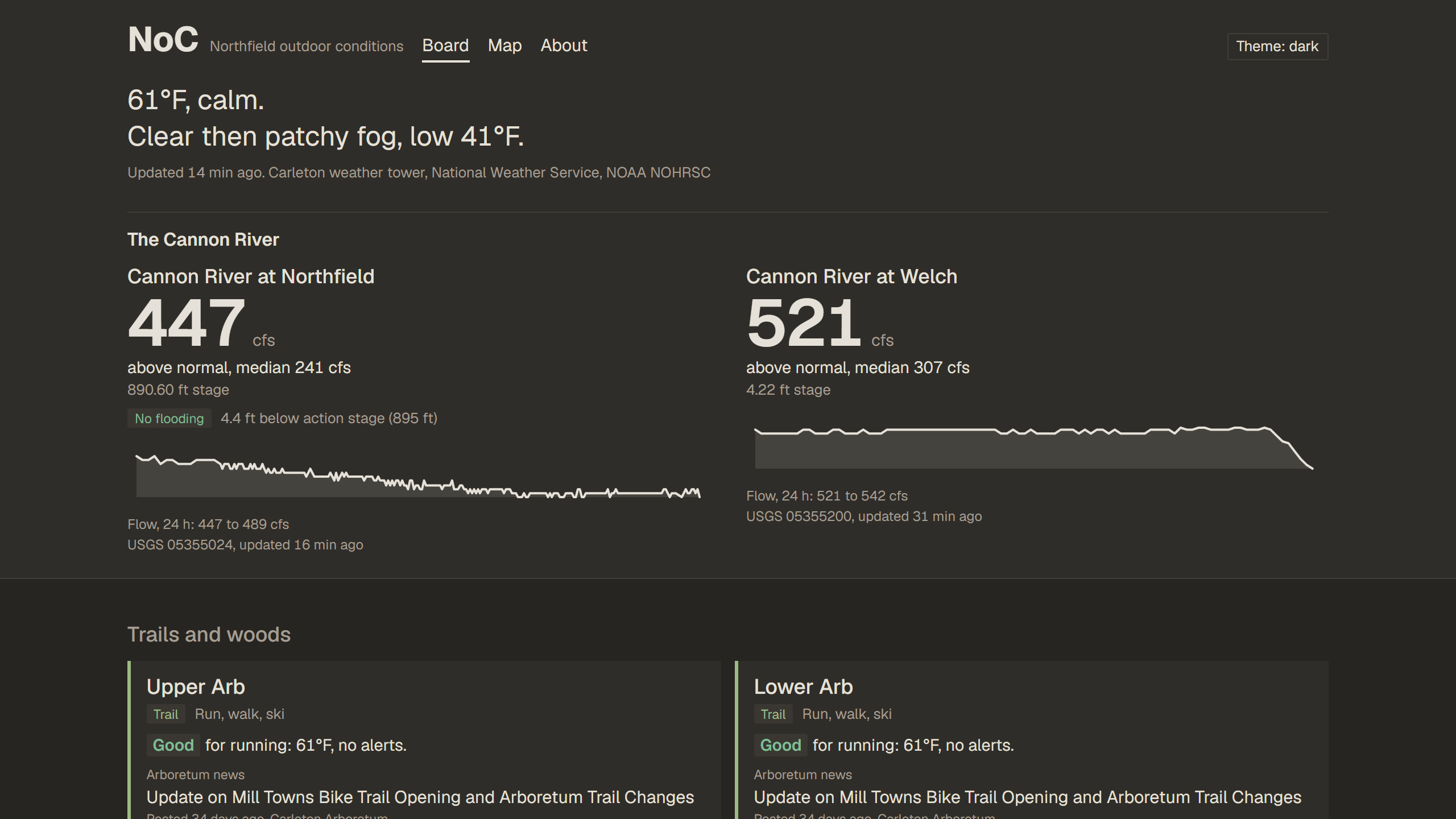
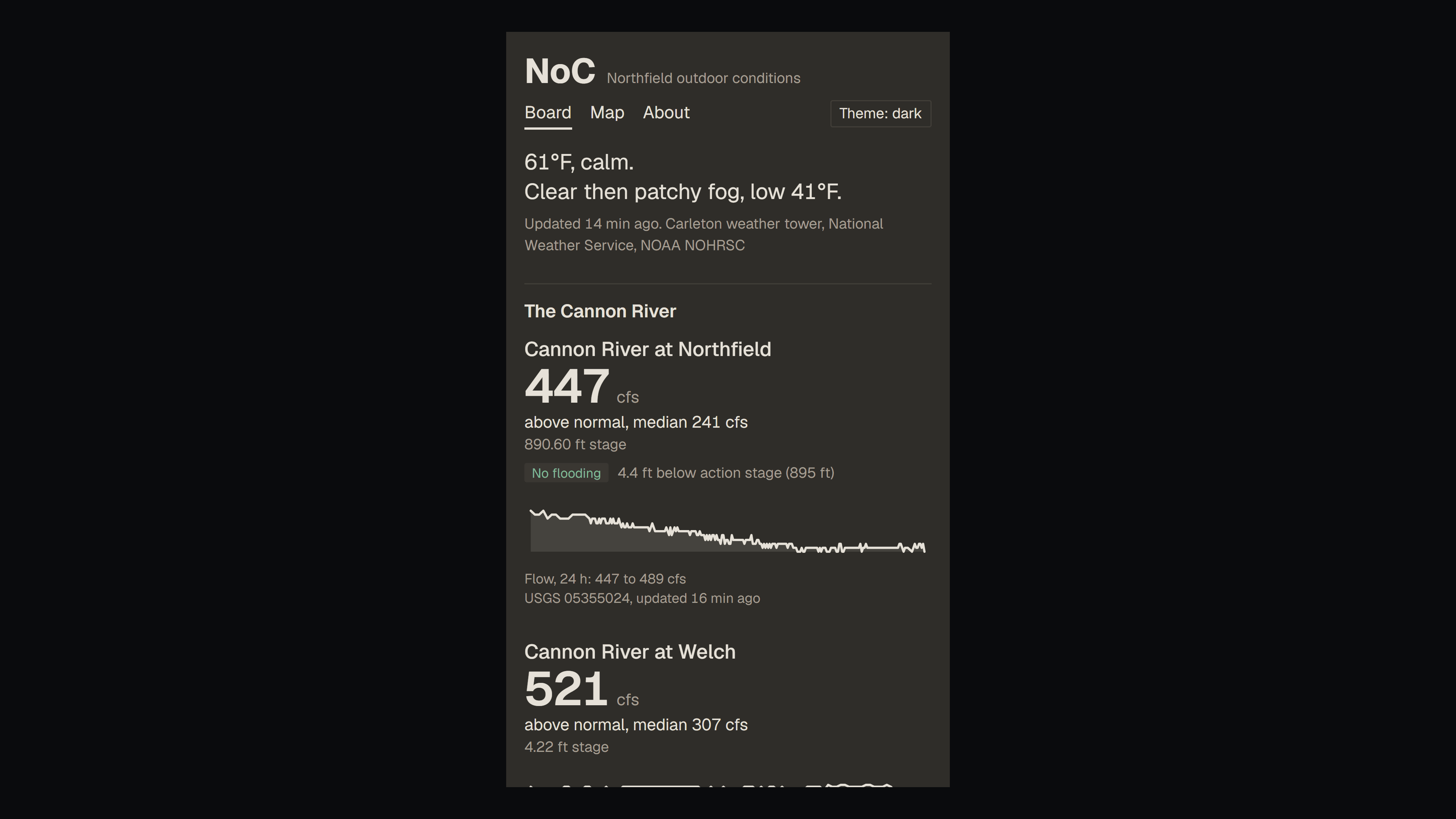
The board answers what it is like out there in one screen. The area-wide readings appear once, as a single sentence at the top: temperature and wind from the Carleton tower, the current forecast period, rain today and snow on the ground. The river strip below it puts Northfield and Welch side by side, with flow as the large numeral, a plain-words comparison with the day's normal and a 24 hour flow sparkline. Each venue card carries only its own feeds, and a venue with no feed of its own says so.
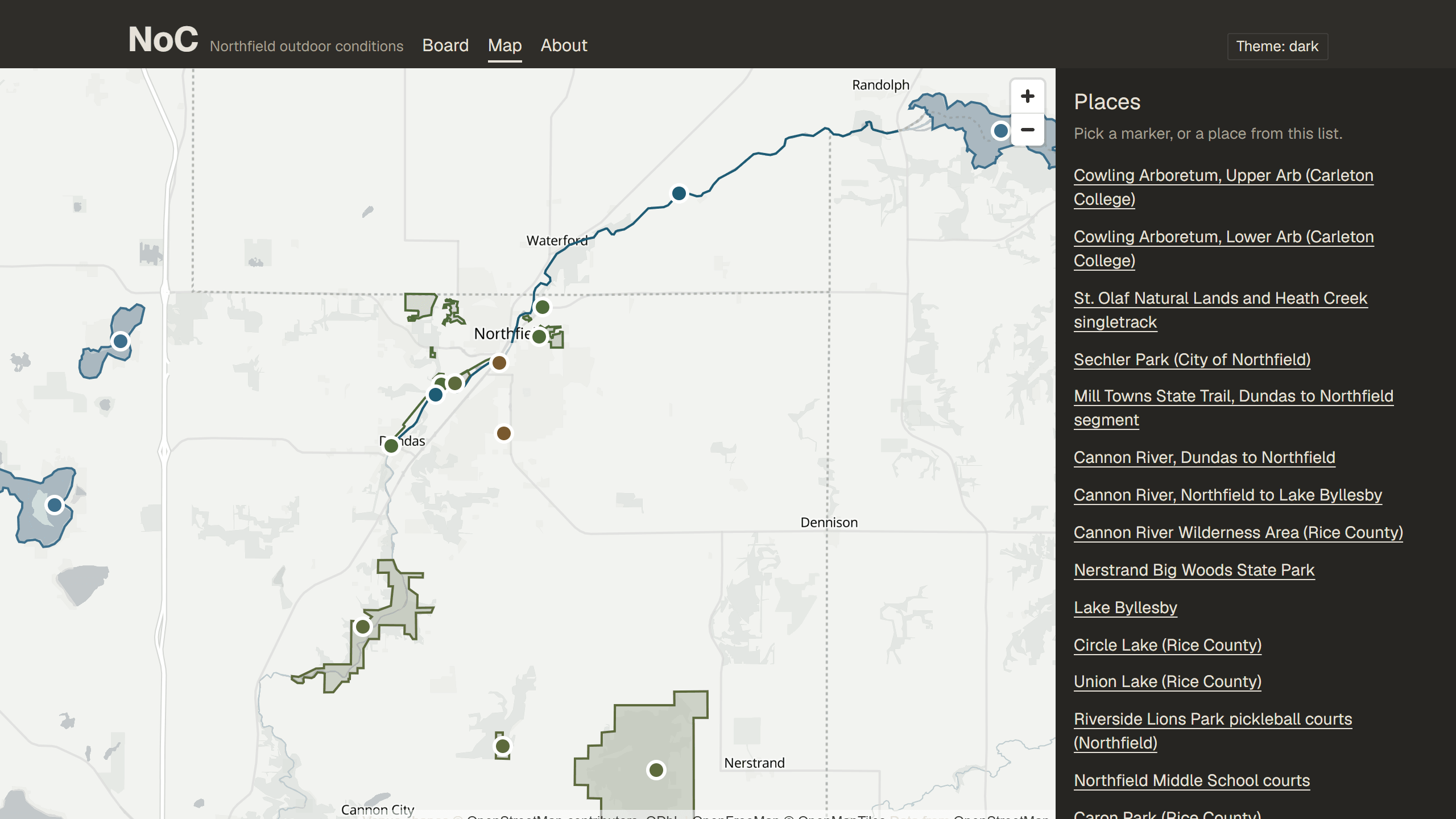
The board and the map are server components rendered with incremental static regeneration. Every database read happens on the server when the page is built or regenerated, at most every five minutes after a request, and an "Updated 2 min ago" style stamp says how old the readings are. The map draws one marker per venue with MapLibre over OpenFreeMap tiles, each venue's OpenStreetMap shape sits under its marker, and clicking a marker shows the same card as the board.
OUTCOME
Live at noc-gamma-gold.vercel.app, deployed from a private repository through Vercel's Git integration. The about page lists every polled source with its public page and how often it runs, and the pollers' User-Agent links there so upstream operators can see who is calling.